
Bill Press: Let America vote: On a national wealth tax


Even if a lot of people won’t admit it, it’s true: A lot of good things started in California.
If you don’t believe it, do what I did. Ask ChatGPT! It identifies no fewer than 20 national political and social movements, from both the political left and right, which started in California and swept across the country.
On the progressive front, thank California for: women’s suffrage, adopted by California in 1911; citizens access to the ballot, led by Governor Hiram Johnson in the early 1990s; farmworker rights, begun by Cesar Chavez and Dolores Huerta in 1992; the free speech movement, Berkeley 1964; the Black Panther movement, Oakland, 1966; the Chicano Rights movement, Los Angeles, 1960s; gay liberation, San Francisco, 1950s to ’ 70s; disability rights, Berkeley, 1960s and ’70s; environmental movement, Santa Barbara oil spill, 1969; antiwar movement, Berkeley and San Francisco, Vietnam war, 1968.
Other cultural and technological revolutions that began in California include: the Beat generation, the Hippie movement, rock music, the surf culture, the organic and natural foods movement, personal computers, and the startup culture.
On the conservative front, for better or worse, California also brought us the Reagan revolution; the tax revolt, starting with Proposition 13 in 1978; and the anti-immigration movement, starting with Proposition 187 in 1994.
To that impressive list, now add one more, an idea that may end up having the greatest impact of them all: a national wealth tax.
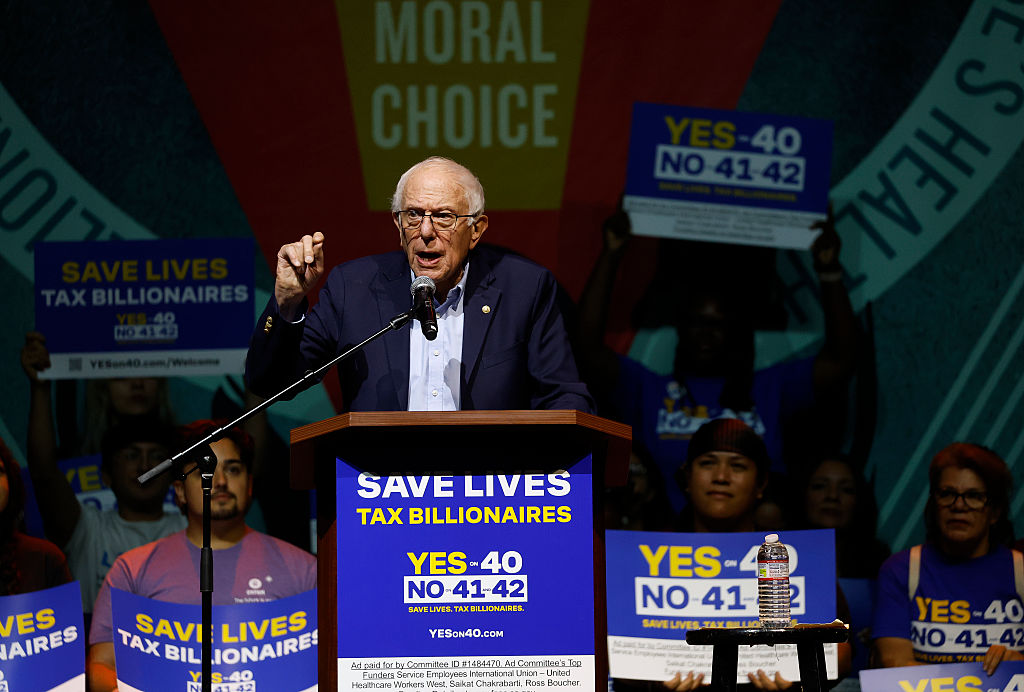
This idea of turning our tax system upside down – in order to tax “wealth,” not “income” – recently had its trial run in California as “Proposition 40” on the November 3 ballot. It lost by five points.
Prop. 40, a one-time, 5 percent tax on total assets held by anyone with a net worth of more than $1 billion, would have generated $100 billion for health care and education. Yet, even though only 250 California billionaires would have had to pay the tax, more than 6.7 million California citizens voted against it – mainly because those greedy 250 billionaires spent $378 million in misleading advertising to defeat it.
But, as with every other important cause, the issue didn’t die its first time out. It was just born there. The seed has been planted and is bound to grow. Even Governor Gavin Newsom, who opposed Proposition 40, said he did so because he believed America needs a national wealth tax, not just a California wealth tax.
There may be no issue more important, nor more relevant to the affordability problems most Americans face today than the ever-increasing gap in wealth between the top 1 percent and working-class Americans. In fact, Scott Ellis, a Silicon Valley business leader and leading supporter of Proposition 40, told me on the Bill Press Pod: “This country I love is in deep trouble. I personally believe that the extreme concentration of wealth and power in a very small number of hands is the most important cause of some of the biggest problems facing our society today.”
As Ellis points out, under our existing “income” tax system, it’s easy for Elon Musk and other billionaires to avoid paying their fair share of taxes. Because they’re so wealthy, they don’t need any income. They simply take out loans against their vast assets, which means they never have a paycheck and very little income to report. It’s a total and, under our present tax system, totally legal, scam.
ProPublica offers Jeff Bezos as a prime example of someone gaming the system. From 2006 to 2018, according to Forbes, his wealth increased by $127 billion, yet he reported only a total of $6.5 billion in income, on which he paid $1.4 billion in taxes. That’s a massive number, but it amounts to only a 1.1 percent true tax rate on the rise in his fortune. Dear reader, you pay a much higher rate.
And, of course, wealth inequality is linked directly to the issue of affordability because those billions of dollars the vastly rich use only to line their own pockets result in higher taxes, higher prices, and cuts in services for the middle-class. As we’re about to experience bigtime in January 2027, when 10 million Americans lose their Medicare coverage in order to pay for Trump’s latest round of tax cuts for the rich.
The ever-increasing wealth gap, Oregon’s Senator Ron Wyden laments, not only leads to higher prices, it erodes Americans’ faith in government and democracy. So let’s fix it by replacing today’s antiquated income tax with a national wealth tax on total assets. Let the debate begin.
(Bill Press is host of The BillPressPod, and author of 10 books, including: “From the Left: My Life in the Crossfire.” His email address is: bill@billpress.com. Readers may also follow him on Twitter @billpresspod and on BlueSky @BillPress.bsky.social.)
©2026 Tribune Content Agency, LLC.



















Comments